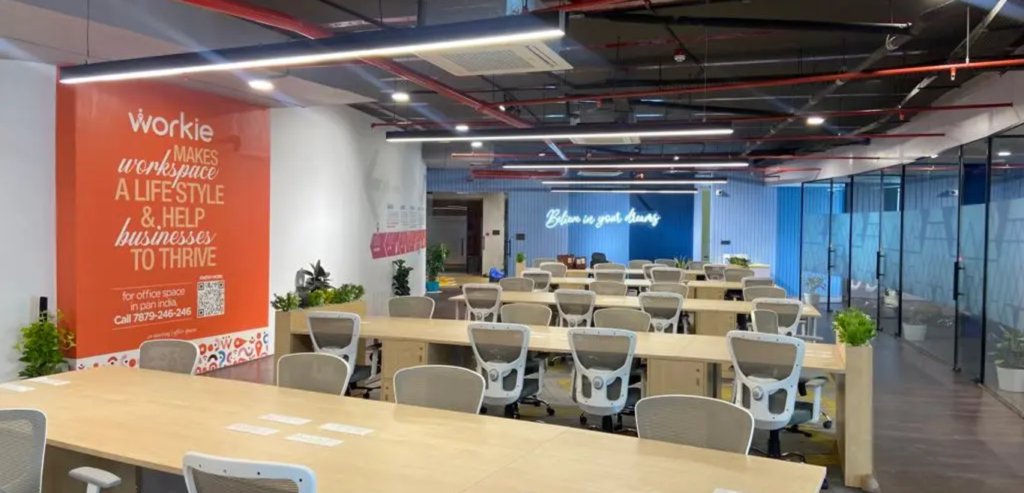
In the modern digital economy, a company’s physical workspace is only as effective as its digital infrastructure. As businesses migrate heavily toward cloud-based applications, unified communications, and real-time collaborative tools, standard internet connections no longer suffice.
For mid-sized enterprises and large corporations, network downtime, high latency, or security breaches can halt operations entirely. This absolute reliance on seamless digital infrastructure has elevated the demand for a specialized real estate solution: the managed office space for enterprise grade connectivity.
Choosing a workspace is no longer just about floor plans, ergonomic furniture, or strategic geographic locations. Today, IT infrastructure takes precedence. Enterprises require dedicated bandwidth, failover redundancies, isolated local area networks (LANs), and stringent cybersecurity protocols.
Building this infrastructure from scratch in a traditional commercial lease requires immense capital expenditure and months of planning. Managed office spaces circumvent these hurdles by providing pre-built, robust network ecosystems designed specifically for high-capacity corporate demands.
This comprehensive guide explores the structural elements that define enterprise-grade internet within managed workspaces. It details why growing companies are pivoting toward these tech-enabled environments, how to evaluate the network capabilities of a prospective office, and how geographic considerations—such as seeking an office space rent in noida expressway—impact connectivity potential.
The Evolution from Traditional Leases to Managed Digital Hubs
The commercial real estate sector has undergone a fundamental transformation in how it serves corporate clients. Historically, securing an office required a company to lease a barren shell. The tenant was responsible for procuring internet service providers (ISPs), running fiber optic cables through the building, installing server racks, and configuring complex network architectures.
The Shift to Operational Agility
Modern businesses prioritize operational agility. Rather than investing heavy capital expenditure (CapEx) into networking hardware that will depreciate, enterprises prefer operational expenditure (OpEx) models. When companies opt for a coworking office space for lease or a fully managed private floor, the core IT infrastructure is already established.
Providers of premium managed offices design their spaces with technology at the forefront. They handle the installation of commercial-grade routers, enterprise firewalls, and high-density Wi-Fi access points. Consequently, the time-to-market for a business expanding into a new region is reduced from several months to mere days.
The Hybrid Work Ecosystem
The definition of the workplace has also expanded. Teams are no longer tethered to a single desk every day of the week. Companies utilize hub-and-spoke models, maintaining a core managed office for primary operations while offering remote employees a day pass coworking space closer to their homes.
For this distributed model to function without friction, the central hub must feature impeccable, secure connectivity to handle constant secure VPN connections from remote workers.
Key Takeaways: The Evolution of the Workspace
- Traditional office leasing requires heavy capital investment in IT infrastructure and long setup times.
- Managed spaces convert IT setup costs from CapEx to OpEx, allowing immediate plug-and-play operations.
- Selecting a premium coworking office space for lease provides companies with pre-installed, high-capacity networking hardware.
- Hub-and-spoke work models rely heavily on the primary office’s ability to support secure, high-volume inbound connections from remote staff.
Defining Enterprise-Grade Connectivity in a Shared Environment
Not all internet connections are created equal. Many standard commercial spaces rely on shared broadband connections, which suffer from contention ratios. This means that during peak hours, bandwidth is throttled as multiple tenants compete for the same connection.
A managed office space for enterprise grade connectivity eliminates this bottleneck through specific architectural principles.
Internet Leased Lines (ILL)
The foundational element of enterprise connectivity is the Internet Leased Line (ILL). Unlike standard broadband, an ILL provides a dedicated, uncontended connection between the ISP and the office. It offers symmetric speeds, meaning the upload speed is identical to the download speed.
For illustrative purposes, an enterprise utilizing cloud-based video rendering or conducting simultaneous high-definition video conferences requires high upload capacities—something consumer broadband rarely provides.
Redundancy and Failover Systems
In an enterprise environment, a single point of failure is unacceptable. If an ISP experiences an outage, work cannot simply stop. Premium managed workspaces install dual-path redundancies. This principle involves contracting with two distinct Tier-1 internet service providers.
The building’s networking hardware is configured so that if the primary line fails or experiences high latency, the system automatically and instantly fails over to the secondary line.
Managing Latency, Jitter, and Packet Loss
Beyond raw speed (bandwidth), network quality is defined by latency (delay in data transmission), jitter (variation in latency), and packet loss (data failing to reach its destination). High latency or packet loss severely degrades Voice over Internet Protocol (VoIP) calls and virtual desktop infrastructure (VDI).
Managed office spaces designed for enterprise clients utilize commercial-grade traffic shaping and Quality of Service (QoS) protocols. These configurations prioritize critical business traffic, ensuring that an essential client presentation is never interrupted by another user downloading large files.
Key Takeaways: Defining Enterprise-Grade Connectivity
- Standard shared broadband is insufficient for enterprises due to fluctuating speeds and contention ratios.
- Internet Leased Lines (ILL) provide dedicated, uncontended, and symmetric bandwidth essential for cloud operations.
- Dual-ISP redundancy guarantees that operations continue seamlessly even if one network provider experiences an outage.
- Enterprise networks actively manage latency, jitter, and packet loss through rigorous Quality of Service (QoS) configurations.
Network Security and Isolation in Managed Offices
A common reservation regarding managed and coworking spaces is the perceived risk of data breaches. Operating within a building alongside other organizations raises valid concerns regarding local area network (LAN) security. However, a properly designed managed office space mitigates these risks entirely through advanced digital isolation techniques.
Virtual Local Area Networks (VLANs)
To maintain strict data confidentiality, enterprise-grade managed spaces utilize VLAN technology. A VLAN logically segments a single physical network into multiple, isolated virtual networks.
For example, a financial services firm leasing a private wing in a managed building will be assigned its own dedicated VLAN. Devices on this network cannot communicate with, or even detect, devices operating on a neighboring company’s VLAN. This ensures that sensitive data streams remain entirely walled off from the rest of the building.
Private Server Infrastructure
While many enterprises are cloud-first, certain industries—such as legal, healthcare, or defense contracting—require on-premises servers for regulatory compliance. Specialized managed spaces accommodate this by offering secure, climate-controlled server rooms.
These facilities provide the necessary power density, uninterruptible power supply (UPS) backups, and biometric access controls required to house proprietary enterprise hardware safely.
Enterprise Firewalls and Threat Management
The perimeter of the building’s network must be guarded by robust cybersecurity hardware. Premium managed spaces deploy unified threat management (UTM) appliances and next-generation firewalls (NGFW).
These systems provide deep packet inspection, intrusion detection, and malware filtering before malicious traffic ever reaches the tenant’s localized network.
Key Takeaways: Network Security and Isolation
- Shared buildings do not equate to shared data; logical segmentation keeps corporate data private.
- VLANs isolate each tenant’s network traffic, preventing cross-company visibility or interference.
- High-end workspaces offer secure, climate-controlled environments for companies requiring on-premises server racks.
- Next-generation firewalls provide a critical first line of defense against external cyber threats targeting the workspace.
Location and Infrastructure: The Noida Expressway Advantage
The physical location of an office directly impacts the quality of its digital infrastructure. Connectivity does not manifest out of thin air; it requires proximity to major fiber optic backbones, robust cellular network towers, and stable electrical grids.
Proximity to Tech Corridors
When businesses look for office space rent in noida expressway, they are deliberately placing themselves in a recognized technology corridor. Regions designated as IT hubs benefit from superior municipal and private infrastructure.
Telecommunication companies prioritize laying high-capacity fiber optic cables in these zones to serve the dense concentration of multinational corporations and software development firms.
Power Infrastructure and Network Uptime
Network connectivity is inextricably linked to power reliability. The most advanced routers and firewalls are rendered useless during a power outage. Corridors like the Noida Expressway are typically supported by robust industrial power grids.
Furthermore, managed office providers in these areas invest heavily in their own power redundancy. A true enterprise-grade space relies on a multi-tiered power strategy: primary grid power, instantaneous UPS battery backups to prevent equipment reboots, and high-capacity diesel generators for sustained outages.
Attracting Tech Talent
Furthermore, positioning a company in a well-connected tech hub aids in talent acquisition. IT professionals, software engineers, and digital marketers expect to work in environments where technology facilitates—rather than hinders—their productivity. By selecting a workspace in a premier business district, companies project an image of stability and modernization.
Key Takeaways: The Noida Expressway Advantage
- Geographic location determines access to premium fiber optic backbones and ISP infrastructure.
- Searching for office space rent in noida expressway aligns businesses with high-tier technological infrastructure and connectivity.
- Uninterrupted power supplies (UPS) and heavy-duty generators are critical to maintaining network uptime.
- Operating in established tech corridors helps attract and retain top-tier digital talent.
Scalability: Adapting IT Needs to Business Growth
Enterprise infrastructure requirements are rarely static. A company may secure a space for fifty employees today, but successfully scaling operations might necessitate space and bandwidth for two hundred employees within a year. A core advantage of the managed workspace model is seamless scalability.
Bandwidth on Demand
In a traditional lease, upgrading internet capacity often requires renegotiating ISP contracts, waiting for physical infrastructure upgrades, or replacing inadequate networking hardware. In a managed office space for enterprise grade connectivity, scaling is largely software-defined and administrative.
Because the physical fiber lines entering the building possess massive total throughput, an enterprise can simply request a bandwidth increase from the workspace management. The provider adjusts the bandwidth allocation on the network switch, granting the company greater capacity almost instantly.
Flexible Workspace Models
Scalability also applies to human capital. When executing temporary projects or scaling up customer support during peak seasons, companies need flexible seating arrangements without compromising their secure network.
For illustrative purposes, an enterprise might lease a secure, private, 50-desk suite on a long-term basis. When a short-term project requires bringing in 20 freelance developers, the company does not need to lease a new suite.
Instead, they can utilize a day pass coworking space within the same building. The IT management team can securely route the network access of these temporary workers into specific, restricted development environments without exposing the core corporate network.
Key Takeaways: Scalability and Flexibility
- Managed spaces allow for instant bandwidth upgrades without the need to install new physical cables.
- Enterprises avoid the strict, inflexible IT contracts associated with traditional commercial leasing.
- Hybrid staffing models are supported by combining dedicated private suites with flexible coworking areas.
- A day pass coworking space can be utilized to accommodate temporary staff while maintaining strict network security protocols.
Evaluating a Workspace: The IT Infrastructure Checklist
Before a business commits to a managed workspace, the IT procurement team must conduct a thorough evaluation of the facility’s technological capabilities. Visual aesthetics and ergonomic chairs are secondary to the structural integrity of the digital environment.
Core Evaluation Criteria
ISP Diversity: Does the building contract with multiple Tier-1 internet service providers? Are the physical cables entering the building through distinct, separate physical conduits (to prevent a single construction accident from severing all connectivity)?
Dedicated Bandwidth Guarantees: Does the service level agreement (SLA) guarantee dedicated bandwidth, or is the connection “up to” a certain speed, implying a shared, contended line?
Wi-Fi Standard and Density: What standard of Wi-Fi access points are installed (e.g., Wi-Fi 6)? Are there enough access points to support the device density of the modern worker, who typically connects a laptop, a smartphone, and a tablet simultaneously?
Custom Routing: Can the enterprise bring in its own specialized routers, firewalls, or SD-WAN appliances, or does the workspace mandate the use of their proprietary hardware?
Static IPs: Does the provider offer multiple static IP addresses required for hosting specific web services or establishing secure site-to-site VPN tunnels?
IT Support: Is there an on-site, dedicated IT support team capable of immediately addressing network anomalies, or is support outsourced to an off-site helpdesk?
By systematically verifying these elements, enterprise IT leaders can ensure the chosen workspace will genuinely support their operational demands rather than act as a bottleneck.
Key Takeaways: Evaluating a Workspace
- IT leaders must interrogate the physical and logical network architecture before signing a workspace agreement.
- Verifying ISP diversity and physical cable routing is essential for true failover redundancy.
- The workspace must provide sufficient Wi-Fi access point density to handle multiple devices per employee.
- Service level agreements (SLAs) must explicitly guarantee dedicated bandwidth rather than shared capacity limits.
Future-Proofing Business Operations
The trajectory of enterprise technology indicates that bandwidth demands will only accelerate. The proliferation of artificial intelligence tools, the normalization of high-definition video conferencing, and the adoption of augmented reality in training modules all require massive, stable data throughput.
Businesses cannot afford to be trapped in workspaces where the digital infrastructure is a decade behind current technology. Future-proofing requires choosing a real estate partner that views connectivity as a core utility, equivalent to water or electricity.
Partnering with Lets Connect India
For companies seeking to establish a resilient, highly connected operational base, partnering with an institutional provider ensures these standards are met. Facilities managed by Lets Connect India are engineered specifically to cater to the stringent IT and connectivity demands of modern enterprises.
By focusing on robust architectural networks, comprehensive power redundancies, and scalable solutions, they provide an environment where businesses can focus entirely on growth rather than troubleshooting local network issues.
Whether a corporation is establishing a new regional headquarters or a startup is transitioning out of an incubation phase, prioritizing a tech-enabled infrastructure ensures that the physical workspace actively enhances, rather than limits, digital capabilities.
Key Takeaways: Future-Proofing Operations
- Bandwidth requirements will continue to rise rapidly with the integration of AI and advanced digital tools.
- Workspaces must be built with forward-looking infrastructure capable of absorbing increased data demands.
- Institutional providers treat enterprise-grade internet as a foundational, non-negotiable utility.
- Lets Connect India provides specialized environments designed to support the complex networking needs of scaling enterprises.
Frequently Asked Questions (FAQs)
1. What is the difference between standard broadband and enterprise-grade connectivity?
Standard broadband is typically a shared connection where bandwidth fluctuates based on the number of active users in the area, resulting in variable speeds and higher latency. Enterprise-grade connectivity uses dedicated Internet Leased Lines (ILL) to provide a private, uncontended connection with guaranteed symmetric speeds and stringent Service Level Agreements (SLAs) for uptime.
2. Why is a managed office space better for IT infrastructure than a traditional lease?
In a traditional lease, the tenant is responsible for the entire IT setup—routing cables, installing servers, and contracting ISPs—which requires high capital expenditure and months of planning. A managed office space is pre-wired with commercial-grade networking equipment, allowing businesses to plug in and begin secure operations immediately under an OpEx model.
3. How do managed workspaces ensure my company’s data remains private?
Premium workspaces use Virtual Local Area Networks (VLANs) to logically segment the building’s internet connection. This ensures that your company’s network traffic is completely isolated and invisible to other companies operating within the same building.
4. What happens if the internet goes down in a managed office?
Enterprise-grade managed offices utilize dual-path redundancy. This principle means the building is connected to at least two different Tier-1 Internet Service Providers. If the primary connection drops, the networking hardware automatically fails over to the secondary connection, preventing operational downtime.
5. Can my company use its own firewall and server equipment in a managed space?
Yes, high-end managed workspaces are designed to be flexible. They often provide secure, climate-controlled server rooms where enterprises can install their own proprietary servers, routers, and next-generation firewalls to maintain internal compliance protocols.
6. Why should tech companies look for office space rent in noida expressway?
The Noida Expressway is a recognized technology corridor. Areas designated as tech hubs feature superior municipal infrastructure, highly reliable industrial power grids, and dense fiber-optic networks. Locating an office here ensures access to the best physical connectivity and a vibrant tech talent pool.
7. Can we easily increase our internet speed if our company grows?
Yes. Unlike traditional leases that may require new physical cables to be run by the ISP, managed offices possess massive inbound bandwidth capacity. Upgrading your company’s internet speed is a simple administrative configuration that can often be executed on the same day it is requested.
8. How do managed offices handle power outages to keep networks running?
Network connectivity requires continuous power. Enterprise-grade spaces use a multi-tiered power strategy: the municipal grid, Uninterruptible Power Supply (UPS) battery systems to prevent equipment from rebooting during a flicker, and heavy-duty diesel generators to supply power during extended outages.
9. Can remote workers safely connect to our network in a managed office?
Yes. Because the managed office provides enterprise-grade speeds and allows for custom hardware (like specialized VPN routers), your IT team can easily configure secure, high-speed inbound connections. This ensures remote employees can access corporate assets safely without experiencing severe lag.
10. What is the benefit of using a day pass coworking space for a large enterprise?
A day pass allows enterprises to maintain ultimate flexibility. If a company experiences a temporary surge in staffing—such as bringing on seasonal contractors or a short-term project team—they can utilize day passes for flexible seating in the same building without having to lease additional, permanent private office space.
Conclusion
The intersection of commercial real estate and digital infrastructure has created a new standard for corporate environments. As business operations become intrinsically linked to cloud technologies and real-time global collaboration, standard office amenities are no longer the primary driver of real estate decisions. The true value lies in a workspace’s ability to guarantee uptime, secure proprietary data, and scale digital capacity on demand.
Opting for a managed office space for enterprise grade connectivity shifts the heavy burden of network engineering, redundancy planning, and cybersecurity maintenance from the tenant to the workspace provider. By choosing locations embedded in robust tech corridors, leveraging dedicated leased lines, and insisting on strict VLAN isolation, enterprises can safeguard their operations against the costly threat of digital downtime.
If your organization is ready to upgrade its operational infrastructure, remove the friction of IT management, and provide your team with a seamless, high-speed environment, it is time to explore specialized workspace solutions. Contact Lets Connect India today to discover how our enterprise-ready managed offices can secure your connectivity, adapt to your scaling workforce, and future-proof your business operations.