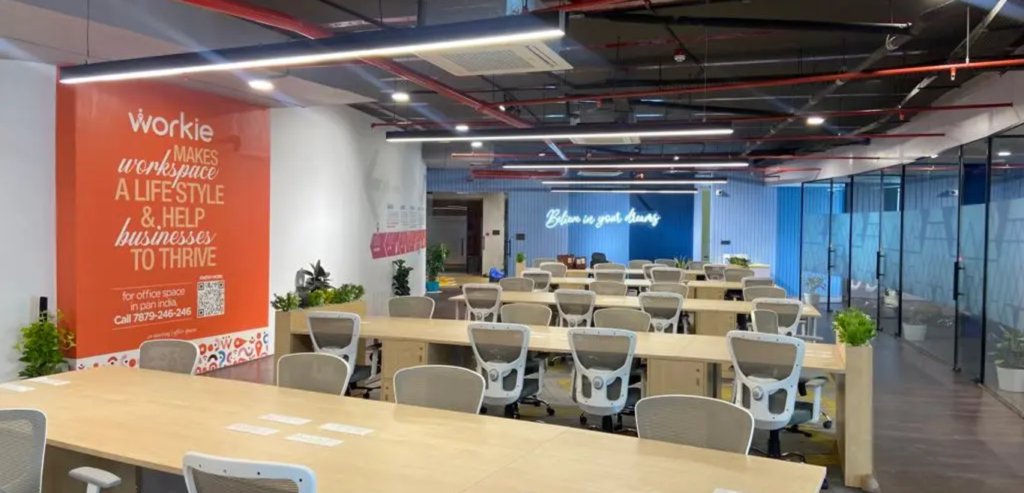
In the evolving landscape of commercial real estate, businesses are fundamentally rethinking how they occupy and manage physical environments. Historically, enterprise real estate strategies relied on long-term leases and static seating arrangements. However, this approach often leads to dormant assets, wasted capital, and inflexible operations.
The modern solution to these inefficiencies lies in rethinking workspace utilization with shared offices. Workspace utilization is the measure of how effectively an organization’s physical office space is being used compared to its maximum capacity.
Optimizing this metric is no longer just about fitting more desks into a room; it is about creating dynamic, adaptable environments that respond to the fluctuating presence of employees. By shifting away from rigid, traditional leases toward flexible alternatives, businesses can align their real estate footprint with their actual daily requirements.
This comprehensive guide explores the principles of maximizing workspace efficiency. It examines the operational benefits of flexible models, the strategic advantages of adopting managed office space, the immediate readiness of plug and play office space, and regional considerations for securing a shared office space in Noida.
By understanding these concepts, organizations can transform their real estate from a static overhead cost into a strategic, agile asset.
Understanding Workspace Utilization in the Modern Era
Workspace utilization is a core metric for corporate real estate planners, facilities managers, and operations leaders. It evaluates the alignment between the physical space a company pays for and the space employees actually use on any given day.
Problem with Traditional Office Leases
In a traditional leasing model, companies must forecast their headcount years in advance. Because growth trajectories are rarely entirely predictable, businesses typically lease more space than they immediately need to accommodate future expansion. Conversely, if an organization downsizes or shifts to a hybrid work model, they are left paying for empty desks, idle meeting rooms, and unused square footage.
When a traditional office operates below its intended capacity, the company still absorbs the full cost of rent, utilities, maintenance, and administrative support. The rigid nature of long-term commercial leases makes it practically impossible to right-size the environment on a month-to-month basis.
The Shift Toward Dynamic Metrics
Modern workspace utilization focuses on dynamic metrics rather than fixed capacities. Planners look at peak occupancy, daily attendance fluctuations, and the usage rates of specific zones (such as collaborative spaces versus quiet focus areas). To optimize these metrics, companies must be able to scale their spatial footprint up or down with ease—a requirement that traditional property markets struggle to facilitate.
Key Takeaways: Understanding Workspace Utilization
- Workspace utilization measures actual space usage against maximum capacity.
- Traditional long-term leases often force companies to pay for unused, dormant space due to rigid terms.
- Modern real estate optimization requires adaptable, dynamic environments rather than static desk assignments.
How Shared Offices Transform Workspace Utilization
The most direct way to improve workspace utilization is to remove the physical boundaries of a traditional lease. Improving workspace utilization with shared offices allows businesses to consume real estate as a service rather than acquiring it as a fixed asset.
Absorbing Headcount Fluctuations
Shared office environments are inherently designed to accommodate change. For example, an expanding startup might begin with a ten-person suite. As they hire more staff, they can easily acquire additional desks or upgrade to a larger suite within the same building. If a project concludes and a team scales down, the business can release the surplus space back to the operator. This flexibility ensures that the organization only pays for the exact amount of space being utilized at any given time.
Shared Amenities and Reduced Footprints
In a conventional office, a company must dedicate square footage to non-revenue-generating spaces such as reception areas, kitchens, bathrooms, and large boardrooms. These areas are essential but are often utilized for only a fraction of the working day.
In a shared office ecosystem, these amenities are centralized and utilized collectively by multiple tenant companies. Because the financial and spatial burden of these common areas is distributed among all members of the workspace, an individual company can significantly reduce its private square footage.
By relying on shared infrastructure for meetings and breaks, a business can maintain a smaller, highly utilized private footprint, driving down overhead costs without sacrificing employee experience.
Key Takeaways: Transformation Through Shared Offices
- Shared offices allow businesses to scale their footprint precisely in line with their current headcount.
- Centralized amenities (kitchens, lounges, meeting rooms) eliminate the need for companies to pay for private spaces that sit empty for most of the day.
- Consuming real estate as a flexible service directly improves overall utilization rates.
Exploring Managed Office Spaces
While standard coworking environments are excellent for freelancers and early-stage startups, mid-sized companies and large enterprises often require a more tailored approach. This is where managed office space becomes a critical component of real estate strategy.
What is Managed Office Space?
A managed office space is an end-to-end real estate solution where a third-party operator sources, builds, and entirely manages the workspace on behalf of a single client. Unlike traditional shared coworking areas where multiple companies sit in an open-plan room, a managed office is entirely private and branded for the occupying company. However, the operational model mirrors that of a flexible workspace.
Balancing Customization with Agility
Managed spaces offer the privacy, security, and brand identity of a traditional headquarters. Organizations can dictate the layout, incorporate enterprise-grade IT infrastructure, and design spatial flows that suit their specific workflows.
Despite this customization, the space remains highly efficient. The third-party operator handles all facility management, including cleaning, utility payments, maintenance, and reception services.This allows the occupying company to maintain a lean internal facilities team.
Furthermore, managed agreements generally offer more flexible lease tenures than conventional commercial real estate, allowing enterprises to adapt their real estate portfolio as their utilization data dictates.
Key Takeaways: Managed Office Space
- Managed spaces provide the privacy and custom branding of a traditional headquarters.
- Third-party operators handle all facility management, reducing administrative burdens.
- Flexible lease structures allow enterprises to align their customized space with actual utilization needs.
The Appeal of Plug and Play Office Spaces
When businesses face rapid changes in staffing or geographical expansion, time to market is a critical factor. Building out a traditional office can take months of planning, construction, and vendor coordination, during which time the capital is deployed without yielding any operational benefit.
Immediate Operational Readiness
A plug and play office space eliminates the friction of office setups. These spaces come fully furnished and pre-equipped with high-speed internet, ergonomic furniture, functional HVAC systems, access control, and printing facilities. An organization can sign an agreement, move their teams into the building, and begin operations on the very same day.
Agility for Project-Based Work
The plug-and-play model is particularly beneficial for project-based initiatives. For instance, an enterprise team deployed to a new city for a six-month consulting project requires professional infrastructure but cannot justify a multi-year lease or a long fit-out period.
A plug-and-play environment provides immediate functionality. By matching the duration of the workspace agreement with the precise timeline of the project, the company ensures optimal workspace utilization and avoids the financial penalty of breaking a long-term lease.
Key Takeaways: Plug and Play Office Space
- Plug-and-play offices eliminate the long lead times associated with traditional office fit-outs.
- Spaces come fully equipped with furniture, IT infrastructure, and utilities.
- They are ideal for rapid market entry, temporary project teams, and maintaining high agility.
Regional Focus: Finding the Right Shared Office Space in Noida
Optimizing workspace utilization also requires strategic geographical placement. For businesses operating in or expanding into the National Capital Region (NCR) of India, finding the right location is paramount for employee retention and operational efficiency.
Noida as a Strategic Business Hub
Noida has rapidly evolved into a premier destination for IT, ITeS, manufacturing, and enterprise businesses. Its wide arterial roads, planned infrastructure, and seamless metro connectivity to Delhi make it a highly accessible location for a diverse workforce.
As commercial hubs mature, companies are increasingly shifting away from isolated standalone buildings in favor of integrated business parks and flexible workspaces.
Matching Local Needs with Shared Infrastructure
For companies seeking a shared office space in Noida, the local market offers an array of sophisticated options. By placing teams in a well-connected shared office, businesses can reduce the commute times for their employees, which often leads to higher daily office attendance and, consequently, better space utilization.
Selecting a shared office in this region allows companies to tap into the vibrant local talent pool while maintaining the agility to scale operations up or down based on market conditions. Additionally, shared operators in Noida frequently provide essential amenities like power backups, high-speed connectivity, and robust security, which are vital for uninterrupted business operations.
Key Takeaways: Shared Office Space in Noida
- Noida offers excellent infrastructure and connectivity, making it a highly desirable business hub.
- Locating a workspace in accessible areas improves employee attendance, thereby boosting utilization rates.
- Shared operators in the region provide robust business continuity infrastructure, essential for enterprise operations.
Strategies to Maximize Workspace Utilization
Transitioning to a flexible or managed workspace is the first step, but ongoing internal strategies are required to keep utilization rates high. Companies must actively manage how their teams interact with the physical environment.
Implementing Activity-Based Working (ABW)
Activity-based working is a design and operational philosophy that provides employees with different types of spaces optimized for specific tasks, rather than tethering them to a single assigned desk.
For example, an office might feature soundproof pods for deep, concentrated work; open collaborative zones for team brainstorming; and traditional desks for standard administrative tasks. Because employees move to the space that best supports their current activity, the overall footprint is used much more efficiently.
Desk Sharing and Agile Seating
When implementing hybrid work policies where employees are not in the office five days a week, a one-to-one desk ratio results in severely poor utilization. Hot-desking or agile seating policies break this limitation.
By operating on a ratio where multiple employees share a single workspace over the course of a week (e.g., a 2-to-1 or 3-to-2 employee-to-desk ratio), companies can comfortably support a large workforce within a relatively compact physical footprint.
Designing for Collaboration Over Isolation
As routine tasks are increasingly handled remotely, the physical office is transforming into a hub for collaboration, culture-building, and training. To optimize utilization, floor plans should prioritize meeting rooms, breakout zones, and project spaces rather than rows of isolated cubicles.
If an office is designed solely for isolated work, employees may simply choose to stay home, leading to vacant desks and low utilization. Designing for interaction draws the workforce in, ensuring the space fulfills its intended purpose.
Key Takeaways: Strategies to Maximize Utilization
- Activity-Based Working (ABW) optimizes space by offering varied environments for different tasks.
- Implementing desk-sharing ratios prevents desks from sitting empty on days hybrid employees work remotely.
- Prioritizing collaborative spaces over isolated cubicles aligns the physical office with modern employee needs.
The Financial and Operational Impact
The ultimate goal of improving workspace utilization is to achieve better financial and operational outcomes. The shift from rigid leases to flexible, shared setups fundamentally alters the economics of running a business.
Transitioning from CapEx to OpEx
Building out a traditional office requires significant Capital Expenditure (CapEx). Companies must finance architectural designs, construction, furniture procurement, and IT installations upfront. By contrast, utilizing shared, managed, or plug-and-play offices shifts the financial model to Operating Expenditure (OpEx).
The workspace provider absorbs the capital costs of the build-out, and the occupying company simply pays a predictable monthly fee. This transition frees up capital that business leaders can redirect toward core revenue-generating activities, such as research, development, and marketing.
Eliminating Dormant Overheads
In a poorly utilized traditional office, the cost per employee skyrockets. If a space is designed for 100 people but only 40 are present, the company is effectively paying more than double the intended facility cost per head.
By closely tracking utilization and migrating to flexible spaces, businesses can eliminate dormant overheads. They only pay for the desks they need, the meeting rooms they use, and the amenities they consume, creating a leaner, more resilient organizational structure.
Key Takeaways: Financial and Operational Impact
- Flexible workspaces shift real estate costs from heavy upfront CapEx to predictable monthly OpEx.
- By right-sizing the workspace, companies drastically lower their facility cost per employee.
- Eliminating dormant overheads builds financial resilience and frees up capital for core business growth.
Frequently Asked Questions (FAQs)
1. What does workspace utilization mean in a corporate context?
Workspace utilization refers to how efficiently an organization’s physical office space is used compared to its total capacity. It measures actual daily occupancy and zone usage rather than just counting the number of desks available.
2. How does a shared office improve overall workspace utilization?
Shared offices improve utilization by allowing companies to share large, common amenities (like boardrooms and cafeterias) with other businesses. This reduces the need for private square footage that would otherwise sit empty for parts of the day.
3. What is the difference between a traditional lease and a managed office space?
A traditional lease provides an empty shell that a company must design, build, and manage themselves over a long-term contract. A managed office space is custom-built and fully operated by a third-party provider, offering privacy and branding with the flexibility of outsourced facilities management.
4. Why is a plug and play office space beneficial for growing startups?
A plug-and-play office space comes fully furnished and equipped with essential IT infrastructure. This allows growing startups to bypass lengthy fit-out periods, move in immediately, and scale their desk requirements rapidly as their team expands.
5. How can hybrid work models negatively impact traditional office leases?
If a company utilizes a hybrid model, employees are in the office on staggered schedules. In a traditional lease with dedicated desks for everyone, this results in high percentages of empty desks on any given day, leading to poor workspace utilization and wasted rent.
6. What factors make Noida an attractive location for shared offices?
Noida boasts robust infrastructure, access to a diverse talent pool, excellent metro connectivity to the wider Delhi NCR region, and a thriving ecosystem of IT and enterprise businesses. This makes a shared office space in Noida a strategic choice for business operations.
7. What is Activity-Based Working (ABW)?
Activity-Based Working is a spatial strategy where employees are not assigned a single fixed desk. Instead, they choose from a variety of settings (quiet pods, collaborative tables, meeting rooms) based on the specific nature of the work they are performing at that moment.
8. How do agile seating or hot-desking strategies work?
Agile seating involves employees sharing a pool of desks rather than having assigned seats. Since not all employees are in the office simultaneously, a company can operate effectively with fewer desks than total employees, maximizing spatial efficiency.
9. Does transitioning to shared or managed workspaces save money?
Yes, primarily by eliminating the capital expenditure (CapEx) required to build out a custom office and by right-sizing the space to remove the costs of unused, dormant real estate. It shifts expenses into a predictable operating expense (OpEx).
10. Can large enterprise companies use shared or flexible workspaces?
Absolutely. While enterprises may not sit in open coworking environments, they heavily utilize managed office spaces or enterprise suites within shared buildings to maintain their brand privacy while benefiting from flexible terms and outsourced management.
Conclusion
The traditional approach to commercial real estate—characterized by long-term leases, high capital expenditures, and rigid floor plans—is no longer sufficient for modern, agile businesses. By actively measuring and optimizing workspace utilization, organizations can drastically reduce operational waste and create environments that better serve their employees.
Improving workspace utilization with shared offices allows businesses to align their physical footprint with their real-time operational needs. Whether leveraging the customized, outsourced benefits of a managed office space, the immediate deployment of a plug and play office space, or establishing a strategic foothold with a shared office space in Noida, flexibility is the key to future-proofing a real estate strategy.
Transitioning to these dynamic models frees up capital, reduces administrative burdens, and fosters a collaborative atmosphere tailored to the modern workforce. For organizations looking to optimize their real estate footprint and discover workspace solutions that drive efficiency, it is time to rethink how your business occupies space. Explore customized, agile, and high-performance environments with Let’s Connect India to find the perfect solution for your growing business needs.