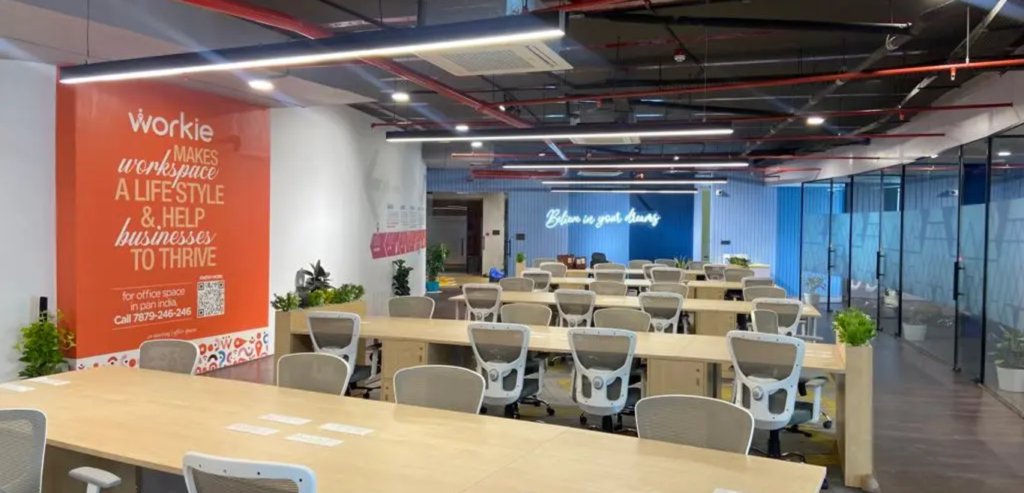
For Small and Medium Enterprises (SMEs), selecting the right geographic location and workspace model is a foundational business decision. The physical office environment dictates much more than just where employees sit; it influences talent acquisition, operational agility, brand perception, and overall team productivity. In recent years, the commercial corridor along the Noida-Greater Noida Expressway has emerged as a premier destination for growing businesses.
Finding the ideal office space for SMEs in Noida Expressway requires balancing multiple competing priorities. Business owners must weigh the necessity for premium infrastructure against budget constraints, while also considering how quickly their team might expand or contract.
Historically, the commercial real estate market forced smaller enterprises into rigid, long-term leases that tied up crucial working capital. Today, the landscape has fundamentally shifted. From a versatile small office space Noida offers to bespoke managed facilities, the options are vastly more accommodating to the volatile nature of growing businesses.
This comprehensive guide explores the various facets of acquiring and optimizing workspace in this bustling commercial corridor. It examines the strategic advantages of the region, the operational benefits of coworking for small teams, the structural efficiencies of managed office solutions Noida provides, and strategies for securing affordable office space Noida without compromising on quality. Furthermore, it highlights how specialized providers like Lets Connect India are reshaping how businesses approach their real estate needs.
The Strategic Advantage of Noida Expressway for SMEs
The Noida Expressway is not merely a transit corridor; it is a meticulously planned commercial ecosystem. For an SME, the surrounding infrastructure of a chosen office location acts as a catalyst for growth.
Connectivity and Accessibility
A primary reason businesses seek office space for SMEs in Noida Expressway is the superior connectivity it offers. The expressway provides a seamless, high-speed link between Delhi and Greater Noida, effectively expanding the talent pool a business can draw from.
Furthermore, the integration of the Aqua Line metro network ensures that daily commuting remains relatively predictable and efficient for the workforce. When employees spend less time and energy navigating arduous commutes, operational efficiency naturally improves.
Proximity to Commercial and Residential Hubs
A well-functioning business district requires a symbiotic relationship with residential zones. The sectors flanking the Noida Expressway integrate commercial towers with structured residential developments, educational institutions, and retail hubs.
This urban planning approach fosters a favorable work-life balance for employees. For an SME aiming to compete with larger corporations for top-tier talent, offering a workplace located in a holistic, accessible, and safe environment is a significant advantage.
A Thriving Business Ecosystem
Positioning a business along the expressway places it in the company of multinational corporations, IT giants, and a multitude of other dynamic SMEs. This proximity facilitates organic networking, localized B2B partnerships, and easier access to shared localized services ranging from IT logistics to corporate catering.
Key Takeaways: The Strategic Advantage
- Noida Expressway provides robust connectivity via road and metro networks, crucial for daily employee commutes.
- The area blends commercial and residential zones, enhancing work-life balance and aiding talent retention.
- Locating in a prominent business corridor naturally integrates SMEs into a broader corporate ecosystem.
Decoding the Workspace Needs of Modern SMEs
The architectural and leasing requirements of a small enterprise differ vastly from those of a multinational conglomerate. While large corporations can project workforce requirements years in advance, SMEs operate with a much higher degree of variability.
Agility Over Permanence
When evaluating a small office space Noida offers, agility is paramount. A rapidly scaling technology startup might double its headcount in a matter of months, whereas a boutique consulting firm might maintain a steady, small team while relying heavily on remote freelancers.
Locking into traditional multi-year leases with rigid spatial configurations can stifle a growing company. Consequently, SMEs are prioritizing spaces that allow for modular expansion—adding desks, private cabins, or entire wings as business requirements dictate.
Capital Expenditure (CapEx) vs. Operating Expenditure (OpEx)
Traditional office leasing requires substantial upfront Capital Expenditure. Businesses must secure the lease, fund the interior fit-outs, purchase furniture, and install IT infrastructure before a single day of work commences.
For an SME, tying up capital in real estate limits the funds available for core business activities like marketing, product development, or hiring. Modern flexible workspaces convert these heavy CapEx requirements into predictable, monthly Operating Expenditures.
Illustrative Scenario: The Scaling Tech Vendor
For example, consider a mid-size software vendor launching a new sales division in North India. Instead of leasing a bare-shell property on the expressway, spending months on interior design, and managing multiple vendor contracts, the vendor can opt for a move-in-ready space.
This allows the sales team to become operational immediately, redirecting the saved capital toward client acquisition rather than office chairs.
Key Takeaways: Workspace Needs
- SMEs require spatial agility to accommodate unpredictable growth trajectories.
- Moving from a CapEx to an OpEx model preserves working capital for core business functions.
- Time-to-market is drastically reduced when businesses choose pre-configured or flexible spaces.
Coworking for Small Teams: Collaboration and Community
For micro-enterprises, startups, and specialized task forces, coworking environments have fundamentally altered the traditional office paradigm.
Plug-and-Play Efficiency
Coworking for small teams is defined by its plug-and-play nature. These environments come fully equipped with ergonomic furniture, enterprise-grade internet, shared meeting rooms, printing stations, and cafeteria services.
A small team of five to ten individuals can tour a facility on a Monday and be fully operational at their new desks by Tuesday. This elimination of setup time is a profound operational advantage.
Networking and Cultural Benefits
Beyond the physical infrastructure, coworking spaces curate a sense of community. Operating a small business can often feel isolating.
By sharing a broader facility with other entrepreneurs and creative professionals, small teams gain exposure to new ideas, potential clients, and collaborative opportunities.
Many coworking operators actively foster this environment through networking events, skill-sharing workshops, and communal wellness activities.
Cost Dilution Through Shared Resources
An independent small office must bear the entire cost of a reception desk, a boardroom, pantry appliances, and IT security. In a coworking model, the costs of these premium amenities are amortized across dozens of member companies.
This economic model enables small teams to access Grade-A infrastructure and aesthetics that would typically be far beyond their individual operational budgets.
Key Takeaways: Coworking
- Coworking eliminates office setup time through plug-and-play infrastructure.
- Shared environments provide natural networking opportunities and combat entrepreneurial isolation.
- SMEs gain access to premium amenities by sharing costs with other resident businesses.
Exploring Managed Office Solutions Noida
While coworking is ideal for micro-teams and startups, an SME that grows past a certain threshold often requires a different approach. Once a company reaches a size of 20, 50, or 100 employees, the need for brand identity and data security becomes paramount.
This is where managed office solutions Noida operators provide bridge the gap between coworking and traditional leasing.
What is a Managed Office?
A managed office is a bespoke workspace that is sourced, built, and operated by a third-party flexible workspace provider, but is entirely dedicated to a single client. Unlike coworking spaces where amenities are shared among multiple companies, a managed office offers a private, secure environment customized to the tenant’s specifications.
Customization and Brand Identity
In a managed workspace, SMEs do not have to compromise on their corporate identity. The layout, color schemes, branding elements, and spatial flow are designed to reflect the company’s culture.
If a business needs a highly collaborative open-plan floor, or conversely, a highly partitioned space for confidential legal work, the managed operator builds it to suit.
Operational Outsourcing
The defining feature of a managed office is that the day-to-day operations remain the responsibility of the workspace provider. Facility management, security, housekeeping, IT troubleshooting, and pantry restocking are all handled by the operator.
The SME pays a single, consolidated monthly invoice. This allows the business owner and HR departments to focus entirely on employee productivity and business growth, rather than dealing with broken air conditioning units or internet outages.
Illustrative Scenario: The Regional Headquarters
Consider a successful South Indian logistics firm setting up its Northern regional headquarters in Noida. The company needs a secure, branded office for 60 employees.
By choosing a managed office solution, they achieve the professional presence of a traditional corporate lease, but without the administrative burden of hiring local facility management staff or coordinating with multiple utilities vendors.
Key Takeaways: Managed Offices
- Managed offices offer entirely private, dedicated spaces tailored for a single enterprise.
- They allow SMEs to project a strong, customized brand identity.
- The operator handles all facility management, consolidating expenses into a single predictable invoice.
Strategies for Securing Affordable Office Space Noida
Affordability in commercial real estate is often misunderstood. For an SME, securing affordable office space Noida provides is not simply about finding the lowest cost per square foot; it is about finding the highest value and minimizing hidden operational costs.
Understanding the Total Cost of Ownership (TCO)
When comparing traditional leases to flexible workspaces, businesses must calculate the Total Cost of Ownership. A traditional lease might advertise a low base rent, but the TCO includes Common Area Maintenance (CAM) charges, electricity bills, high-speed internet line rentals, security personnel wages, housekeeping salaries, and ongoing repair costs.
When all these hidden expenses are tallied, flexible and managed workspaces often prove to be more economically viable, providing true affordability.
Strategic Location Selection
While the primary sectors immediately adjacent to the start of the Noida Expressway command premium pricing, exploring sectors situated slightly further down the corridor can yield significant cost savings without a drastic reduction in connectivity.
SMEs must evaluate whether their business model absolutely requires a landmark building, or if a highly functional space a few minutes away will suffice.
Flexible Terms Mitigate Financial Risk
Affordability is also intrinsically linked to risk management. Long-term leases usually involve severe financial penalties for early termination.
Flexible spaces offer shorter lock-in periods, meaning an SME can downsize quickly during an economic downturn without facing crippling exit costs. This contractual flexibility is a core pillar of long-term financial affordability.
Key Takeaways: Affordability
- True affordability must be measured by the Total Cost of Ownership, not just base rent.
- Consolidated invoices in flexible spaces eliminate surprise maintenance and utility costs.
- Shorter lock-in periods protect businesses from the financial risks associated with long-term real estate liabilities.
Essential Amenities for Modern Workforces
To remain competitive, any office space for SMEs in Noida Expressway must feature amenities that meet the expectations of the modern workforce. The physical environment plays a crucial role in employee satisfaction and retention.
Ergonomics and Wellness
Workspace design has evolved to prioritize physical well-being. Quality office spaces now feature ergonomic seating, height-adjustable desks, and abundant natural light.
Environments that prioritize these elements help reduce physical fatigue and maintain high productivity levels throughout the workday.
Furthermore, access to clean air via sophisticated HVAC filtration systems has become a non-negotiable requirement for many businesses.
Robust IT and Security Infrastructure
For nearly all modern SMEs, downtime is disastrous. Reliable, high-speed internet with redundancy protocols is the backbone of daily operations. In addition to digital infrastructure, physical security—including biometric access controls, CCTV surveillance, and secure visitor management systems—is essential for protecting company assets and ensuring employee safety.
Collaborative and Breakout Zones
Employees require varied environments to perform different types of tasks. While focused work requires quiet zones or individual desks, brainstorming sessions benefit from casual, lounge-style breakout areas.
Access to fully stocked cafeterias or high-quality coffee machines further enhances the daily experience, encouraging employees to take necessary mental breaks without leaving the premises.
Key Takeaways: Essential Amenities
- Ergonomic furniture and natural light are vital for maintaining employee health and productivity.\
- Uninterrupted, secure IT infrastructure is a mandatory baseline for any commercial space.
- A mix of focused work zones and casual breakout areas caters to diverse daily tasks.
Discovering the Right Fit with Lets Connect India
Navigating the complexities of commercial real estate can be overwhelming for business owners. Identifying the right layout, negotiating lease terms, and managing operational logistics take time away from core business objectives. This is where specialized platforms step in.
Lets Connect India positions itself as a strategic partner for businesses seeking an optimized working environment. Focusing heavily on the nuanced requirements of growing enterprises, Lets Connect India offers tailored workspace solutions designed to foster productivity and innovation.
Curated Solutions for Diverse Needs
Whether a business is looking for a vibrant coworking environment for a handful of developers, or a highly secure managed office solution for a large customer support team, Lets Connect India provides access to premium ecosystems.
By deeply understanding the geographical advantages of regions like the Noida Expressway, the brand facilitates matches that align with an SME’s specific logistical and financial parameters.
Simplifying the Real Estate Journey
Lets Connect India simplifies the transition into a new workspace. By absorbing the administrative friction associated with facility setup and ongoing management, they allow SME leaders to maintain singular focus on their organizational goals.
Their spaces are designed not just as physical locations, but as growth-enabling environments where businesses can thrive without the traditional burdens of real estate management.
Key Takeaways: Lets Connect India
- Lets Connect India acts as a strategic partner in finding tailored workspace solutions.\
- They provide access to a spectrum of options, from collaborative coworking to private managed offices.
- Partnering with specialized providers removes the administrative friction of workspace management.
FAQ: Office Space for SMEs in Noida Expressway
1. Why is the Noida Expressway considered a prime location for SMEs?
The Noida Expressway offers an excellent mix of high-speed road connectivity, metro access, modern infrastructure, and proximity to both residential hubs and major corporate ecosystems, making it highly attractive for business operations.
2. What is the difference between a traditional office and a managed office space?
A traditional office requires the business to design, furnish, and operate the space independently. A managed office is customized for the business but fully operated and maintained by a third-party provider for a single monthly fee.
3. Is coworking suitable for an established small business?
Yes, coworking for small teams is highly suitable for established businesses. It provides flexibility, reduces capital expenditure, and offers access to premium amenities and meeting rooms without the overhead of maintaining them.
4. How do I find affordable office space Noida without sacrificing quality?
Focus on the Total Cost of Ownership rather than just the base rent. Opting for flexible or managed workspaces often provides better value because utility, maintenance, and internet costs are bundled into the price.
5. What are the typical hidden costs in traditional commercial leasing?
Hidden costs in traditional leases generally include Common Area Maintenance (CAM), security personnel, housekeeping staff, facility repairs, utility bills, and the initial capital required for interior fit-outs.
6. Can managed office solutions Noida accommodate sudden team expansion?
Yes. Managed and flexible office providers are designed for agility. In most cases, they can allocate additional desks, reconfigure floor plans, or provide access to adjacent suites much faster than a traditional landlord.
7. How does a workspace location impact employee retention?
Location dictates the daily commute. An office situated in a well-connected, safe area with nearby residential and retail options significantly improves work-life balance, which is a major factor in retaining top talent.
8. What amenities should an SME look for in a modern office space?
SMEs should prioritize high-speed internet with backup, ergonomic furniture, 24/7 access, meeting room availability, biometric security, and comfortable breakout or cafeteria zones for employees.
9. How does Lets Connect India help SMEs find workspace?
Lets Connect India partners with businesses to understand their specific spatial, operational, and budgetary needs, providing access to curated, ready-to-use coworking and managed office solutions.
10. Is it better for a startup to choose a bare-shell property or a plug-and-play office?
For almost all startups, a plug-and-play office is better. It preserves crucial working capital by eliminating CapEx on interiors and allows the team to begin working immediately without managing construction vendors.
Conclusion
Securing the right office space for SMEs in Noida Expressway is a strategic maneuver that can significantly influence a company’s trajectory. The evolution of commercial real estate has shifted the power dynamic in favor of growing businesses.
Gone are the days when SMEs were forced to accept the heavy financial burdens of traditional, inflexible leases. Today, through the availability of a diverse small office space Noida market, agile enterprises can choose environments that precisely match their current phase of growth.
Whether prioritizing the collaborative energy of coworking for small teams or the bespoke, secure environment of managed office solutions Noida providers offer, business leaders can now optimize their real estate strategies for operational expenditure rather than capital drain.
By focusing on true value and total cost of ownership, securing an affordable office space Noida is an entirely achievable goal that does not require sacrificing premium amenities or strategic connectivity.
As you plan the next phase of your company’s growth, choosing a partner who understands the unique demands of the SME landscape is crucial. Discover how effortless transitioning to a premium workspace can be, and empower your team in an environment built for success.
Explore tailored, flexible, and fully managed workspace solutions with Lets Connect India ftoday, and take the next confident step in your business journey.