For IT business leaders, facility managers, and enterprise expansion teams, selecting a commercial real estate location goes far beyond square footage and leasing rates. The operational viability of a tech hub hinges on multi-modal transit, robust power infrastructure, and the ability to attract and retain top-tier talent from across the National Capital Region (NCR). As companies evaluate their options along the Noida-Greater Noida Expressway, securing a high-connectivity office in Sector 136 has emerged as a strategic priority.
However, evaluating this sector requires looking past the marketing hype. Decision-makers need to know if Sector 136 actually has the metro accessibility and last-mile infrastructure their IT teams require. They need to understand the regulatory zoning, the building standards, and the realities of establishing a presence in a developing commercial corridor.
This comprehensive guide examines Sector 136 from a purely operational standpoint. It explores transit realities—including expressway access and metro integration—zoning regulations, real estate availability, and flexible workspace ecosystems. By analyzing these factors, IT business leaders can confidently determine whether Sector 136 aligns with their operational needs and talent recruitment goals before committing to site visits.
The Connectivity Reality: Multi-Modal Transit for IT Operations
When evaluating a high-connectivity office in Sector 136, transit infrastructure is the primary decision driver. IT operations require predictable, low-friction commute options for employees traveling from diverse regions, including Delhi, Gurugram, and Faridabad.
Sector 136 addresses these needs through a combination of arterial highways, established metro interchanges, and local light-rail access.
The Arterial Backbone: Noida-Greater Noida Expressway
The foundation of Sector 136’s connectivity is its direct placement along the Noida-Greater Noida Expressway. This 24.53 km long, six-lane controlled-access highway serves as the primary arterial road for the region’s commercial and IT sectors.
For businesses relying on company shuttles, private cabs, or employees driving personal vehicles, the expressway provides high-speed, seamless access, effectively bypassing the congestion often found in deeper urban residential zones.
The Talent Gateway: Botanical Garden Interchange
For talent commuting from South Delhi or Gurugram, securing an office near Botanical Garden Metro station is highly desirable. While Sector 136 is located further down the expressway, the Botanical Garden station acts as the critical transit gateway for the area.
As the Delhi Metro Rail Corporation’s (DMRC) first interchange station, it connects the Blue Line and the Magenta Line. This interchange significantly reduces travel time between Noida, South Delhi, and Gurugram.
IT professionals can leverage this high-capacity hub to connect with feeder buses, shared transit, or corporate shuttles that run directly down the expressway to Sector 136.
Local Metro Access: The Aqua Line Connection
For last-mile connectivity, IT firms seeking metro connected office space in Sector 136 look toward the local infrastructure provided by the Noida Metro Rail Corporation (NMRC). The Sector 137 Metro Station on the Aqua Line provides direct, walkable, or short-commute access to adjacent commercial zones.
This station acts as the immediate local rail link, drastically reducing the last-mile friction for employees. Furthermore, organizations searching for an office near ATS Noida Metro link landmarks will find that the commercial developments in Sector 136 naturally integrate with these established transit nodes, creating a cohesive transport network.
Key Takeaways:
- Sector 136 relies on a multi-modal transit strategy: the 24.53 km expressway for road transport, Botanical Garden for cross-NCR metro talent, and the Sector 137 Aqua Line station for local rail access.
- The Botanical Garden interchange is essential for recruiting talent from South Delhi and Gurugram, feeding into expressway-based last-mile transit.
- Local metro availability limits reliance on private vehicles, supporting broader talent acquisition.
Infrastructure, Zoning, and Building Standards
Transit alone does not make a sector suitable for IT operations. The underlying physical infrastructure, regulatory zoning, and building standards must be capable of supporting high-density tech environments.
IT/ITeS Zoning and Master Plan Integration
One of the most critical factors for enterprise tenants is regulatory compliance. Under the Noida Master Plan 2031, sectors along the Noida-Greater Noida Expressway—including Sector 136—are formally zoned for IT, ITeS (Information Technology Enabled Services), and institutional land use.
This is not merely a bureaucratic designation; it ensures that the local power grids, broadband infrastructure, and municipal services are purposefully engineered to foster a dedicated tech business ecosystem. IT firms operating here face fewer zoning hurdles and regulatory delays compared to mixed-use or purely commercial sectors.
Grade A Office Specifications
Offices in this designated tech corridor are generally built to accommodate the rigorous demands of global tech firms. While specific building amenities vary, facilities in this zone typically offer:
- High-Capacity Power and Cooling: Essential for server rooms, continuous operations, and densely packed engineering floors.
- Data Center Readiness: Provisions for high-speed fiber optic connectivity, multiple ISP redundancies, and structural floor loading capacities capable of supporting heavy IT equipment.
- Scalable Floor Plates: Contiguous office spaces that allow mid-sized and enterprise firms to design agile, collaborative work environments without fragmenting their teams across multiple floors or towers.
Key Takeaways:
- Sector 136 is officially zoned for IT/ITeS under the Noida Master Plan 2031, streamlining compliance for tech companies.
- Buildings in this corridor are specifically developed to support the power, cooling, and bandwidth requirements of high-density tech operations.
Flexible Workspaces and the Ecosystem Maturity
As the IT industry evolves toward hybrid work models, the presence of flexible, managed workspaces within a sector is a major competitive advantage. Enterprise teams often require satellite offices, while tech startups need scalable infrastructure without heavy capital expenditure.
Managed Office Solutions: Let’s Connect India
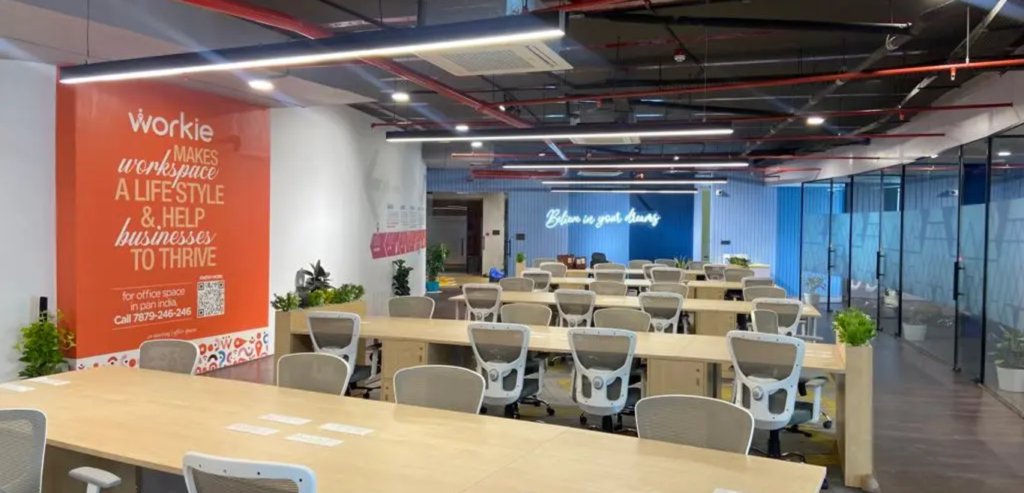
The ecosystem in Sector 136 is maturing to include high-quality, managed environments. A prime example is Let’s Connect India, which operates a dedicated coworking and managed office facility in Sector 136, Noida. This facility provides flexible workspace solutions specifically targeted at IT businesses, startups, and corporate teams.
By utilizing providers like Let’s Connect India, organizations can rapidly establish a presence in the sector, bypass the delays of custom fit-outs, and scale their real estate footprint in tandem with their headcount.
Amenities and Employee Well-Being
Beyond the desk, the surrounding ecosystem heavily influences employee satisfaction. The development of Food & Beverage (F&B) outlets, wellness centers, and retail conveniences within and adjacent to Sector 136 is actively growing.
Additionally, the strategic location along the expressway offers qualitative benefits, such as relative proximity to green spaces like the Noida Botanical Garden. This differentiation from dense, concrete-only business parks supports a better work-life balance, which is a key metric for modern talent retention.
Key Takeaways:
- Flexible workspace providers like Let’s Connect India offer ready-to-deploy environments for agile IT teams.
- The ecosystem is maturing to support employee well-being through nearby amenities and managed service options.
Talent Attraction and the Cost of Commute
For IT operations, real estate is fundamentally a human resources tool. The decision to lease a high-connectivity office in Sector 136 must map directly to talent acquisition strategies.
Reducing Recruitment Friction
Complex, expensive, or unpredictable commutes actively deter top engineering and development talent. Sector 136 mitigates this friction. An employee residing in South Delhi can utilize the Magenta Line to reach the Botanical Garden interchange rapidly, bypassing hours of road traffic.
From there, dedicated corporate shuttles or local transit down the six-lane expressway make the final leg of the journey highly predictable.
Broadening the Talent Catchment Area
Because the Botanical Garden station bridges the Blue and Magenta lines, Sector 136 effectively widens its talent catchment area. HR teams are not restricted to hiring solely from within Noida; they can comfortably target professionals in Gurugram, Central Delhi, and East Delhi.
The integration of the Sector 137 Aqua Line station further ensures that talent residing in Greater Noida and deeper Noida sectors has a reliable, traffic-free rail option right to the office’s doorstep.
Key Takeaways:
- Transit predictability reduces the “cost of commute” (both in time and financial expense) for employees.
- The combined network of DMRC interchanges and NMRC local lines allows HR teams to recruit from across the entire NCR.
Real Estate Availability and Market Dynamics
Understanding the real estate dynamics in Sector 136 requires an objective look at current market realities, distinct from future aspirational developments.
Availability and Scalability
Sector 136 is experiencing strong institutional interest and a growing tenant footprint, particularly from the tech sector. While exact occupancy percentages fluctuate, the qualitative consensus points to high demand for Grade A spaces.
IT companies with large headcounts (e.g., 500+ employees) can often find contiguous, scalable office space, provided they engage the market with a clear growth timeline. Landlords in this IT/ITeS zoned area are highly accustomed to the specific leasing structures required by tech firms, often offering flexible terms that accommodate rapid scaling or phased move-ins.
Acknowledging the Trade-Offs
Pragmatic decision-makers must also acknowledge the realities of moving into a rapidly developing corridor. While the core infrastructure (expressway, power grid) is robust, localized construction for new commercial towers and adjacent transit links can cause temporary friction.
Companies evaluating Sector 136 should assess their tolerance for near-term localized traffic during peak construction phases, balancing this against the long-term benefits of a purpose-built IT ecosystem.
Key Takeaways:
- Contiguous, scalable office spaces are generally available for enterprise IT firms, supported by tech-friendly lease structures.
- Prospective tenants must factor in the localized friction of ongoing commercial construction when planning their operational timelines.
Risk Assessment: Is Sector 136 Right for Your Business?
Not every location is suited for every business. A thorough risk assessment is critical before signing a commercial lease.
Who Should Consider Sector 136
- Mid-to-Large IT Enterprises: Companies that require 50,000+ sq. ft. of contiguous space, robust power backup, and dedicated server infrastructure.
- Companies with Dispersed Workforces: Businesses whose talent pool spans Delhi, Gurugram, and Greater Noida, requiring centralized access via the expressway and metro interchanges.
- Hybrid Operations: Organizations looking to utilize managed workspaces (like Let’s Connect India) alongside traditional leased headquarters.
Who Should Evaluate Carefully
- Heavy Logistics/Manufacturing Firms: The sector is strictly zoned for IT/ITeS and institutional use under the Master Plan 2031; non-tech industrial operations will face zoning restrictions.
- Businesses Requiring Immediate Pedestrian Footfall: This is a destination business hub, not a high-street retail zone. Companies reliant on walk-in B2C traffic will not find the ecosystem suitable.
Key Takeaways:
- Sector 136 is highly optimized for tech firms, startups, and hybrid IT teams.
- Zoning regulations strictly favor IT/ITeS, making it unsuitable for heavy industrial or walk-in retail businesses.
Illustrative Tenant Perspective: Evaluating the Move
Consider a mid-sized IT services company with 600 employees, currently outgrowing its fragmented office space in a congested area of Delhi. The leadership team evaluates Sector 136 based on three core pillars:
Commute Time: The HR director notes that 40% of their engineering staff lives in Gurugram and South Delhi. By choosing an office near ATS Noida Metro link transit routes and leveraging the Botanical Garden interchange, the company calculates that average commute times will become highly predictable.
Infrastructure Readiness: The CTO requires a facility with redundant fiber connections and heavy floor-load capacity for localized server racks. The IT/ITeS zoned buildings in Sector 136 meet these criteria by default.
Scalability: Unsure of exact headcount growth for the next two years, the operations team opts for a hybrid approach. They secure a core traditional lease for 400 employees and utilize a flexible coworking partner within the sector, like Let’s Connect India, to house project-based contractors and agile teams, mitigating real estate risk.
By aligning the sector’s connectivity and zoning benefits with their operational pain points, the company confidently executes the relocation.
Frequently Asked Questions (FAQ)
1. Does Sector 136 actually have the metro connectivity required for a large IT workforce?
Yes. Local access is supported by the Sector 137 station on the Aqua Line, which serves as a highly accessible drop-off point. Additionally, the Noida-Greater Noida Expressway allows seamless feeder bus and shuttle connectivity from the Botanical Garden interchange.
2. How does the Botanical Garden Metro station impact the commute to Sector 136?
As the DMRC’s first interchange station (Blue and Magenta lines), it significantly reduces travel time for talent coming from South Delhi and Gurugram. Employees can exit at Botanical Garden and take a fast, straight-line shuttle or bus down the 24.53 km expressway directly to Sector 136.
3. What makes Sector 136 different from other commercial zones in Noida?
Under the Noida Master Plan 2031, Sector 136 is formally zoned for IT/ITeS and institutional use. This means the infrastructure—from power grids to broadband—is purposefully built for tech companies, unlike mixed-use zones that blend heavy residential or industrial elements.
4. Can an enterprise IT company find scalable, contiguous space here?
Typically, yes. Because the area is developed specifically for institutional and IT operations, many buildings feature large, scalable floor plates designed to house enterprise teams of 500+ employees without splitting them across multiple towers.
5. Is there managed or flexible workspace available in Sector 136?
Yes. For businesses requiring agile solutions, providers like Let’s Connect India operate dedicated coworking and managed office facilities in Sector 136, catering directly to IT businesses, startups, and corporate teams needing flexible terms.
6. Are there any zoning restrictions I should be aware of?
Yes. The land use is strictly regulated under the Noida Master Plan 2031. It is meant for IT, ITeS, and institutional operations. Traditional manufacturing, heavy logistics, or non-compliant commercial retail operations may face strict regulatory approvals or outright restrictions.
7. How does the expressway benefit employees who drive?
The Noida-Greater Noida Expressway is a 24.53 km long, six-lane controlled-access highway. It allows employees using personal vehicles or company cabs to bypass deep-city traffic, resulting in a high-speed, predictable daily commute.
8. What happens during localized construction phases? Will connectivity be disrupted?
As with any developing commercial hub, ongoing construction of new towers can cause localized dust and minor traffic diversions during peak hours. However, the primary arterial access via the expressway generally remains robust and unaffected.
9. When will any future ATS Noida Metro Link extensions be fully operational?
For the most accurate and up-to-date timelines regarding any future metro extensions or link completions, businesses should refer directly to official announcements from the Noida Metro Rail Corporation (NMRC), as construction schedules are subject to municipal updates.
10. How does proximity to green spaces like the Botanical Garden affect tenant recruitment?
Modern IT talent heavily values work-life balance and environmental quality. While Sector 136 is a business hub, its connectivity to the broader Noida ecosystem—including proximity to established green zones via transit—provides a qualitative edge over densely packed, concrete-only industrial parks when pitching the workplace to new recruits.
Conclusion
Securing a high-connectivity office in Sector 136 is a strategic maneuver for IT enterprises prioritizing talent mobility, scalable infrastructure, and regulatory compliance. By leveraging the six-lane Noida-Greater Noida Expressway, the critical Botanical Garden metro interchange, and local Aqua Line access, businesses can effectively eliminate the commute friction that often hinders recruitment across the NCR.
Furthermore, with formalized IT/ITeS zoning under the Noida Master Plan 2031 and the availability of flexible workspaces like Let’s Connect India, Sector 136 provides an ecosystem purpose-built for the demands of modern technology operations. While businesses must pragmatically evaluate their specific space requirements and localized development trade-offs, the foundational connectivity of Sector 136 makes it a highly viable, future-ready hub.
Are you ready to evaluate how Sector 136 aligns with your enterprise growth strategy? Begin by assessing your team’s geographic distribution to determine transit suitability, and explore the specialized IT/ITeS commercial real estate options available along the Noida-Greater Noida Expressway today.